



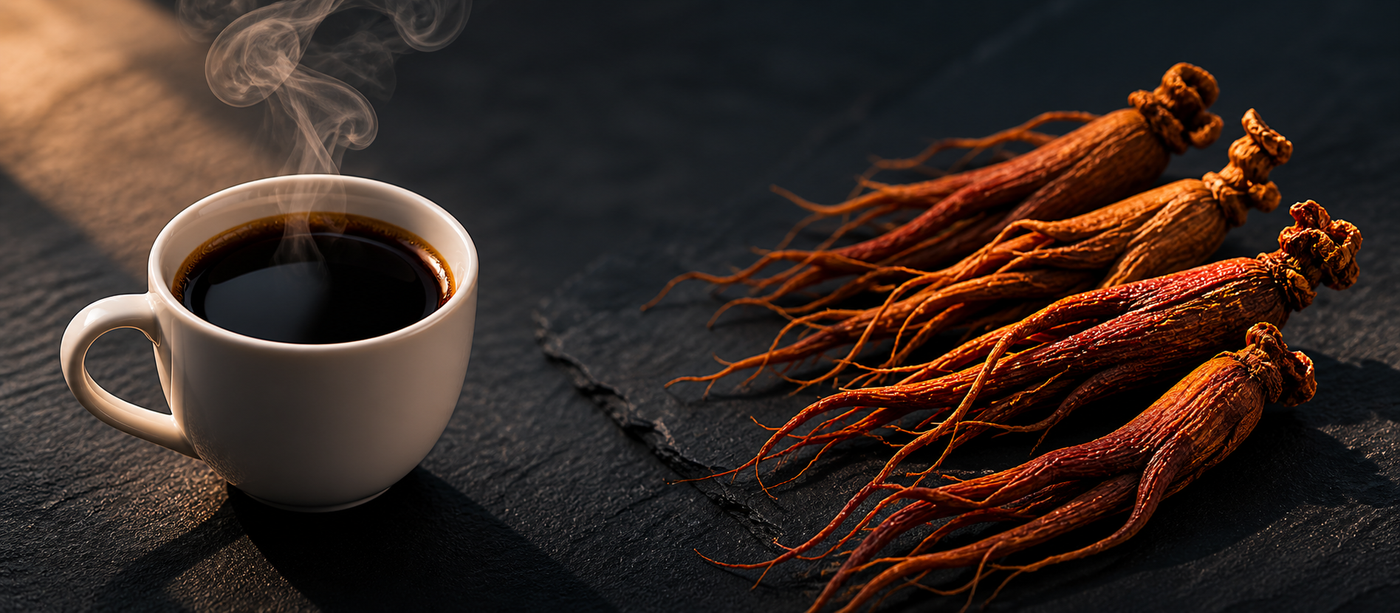
Every morning, roughly 400 million cups of coffee are consumed in America. Most people are not drinking coffee because they love it. They are drinking it because they need it — because without it, they don't feel like themselves.
If that sounds familiar, you're not broken. You've just been borrowing energy from a system that charges compound interest. Caffeine doesn't create energy. It blocks the signal that tells your brain you're tired — until the signal returns, louder than before.
Korean Red Ginseng works differently. And the difference is not subtle.
of caffeine users say they would try a natural, non-caffeine alternative if it delivered the same energy results — without the crash or the dependency.
Source: Korea Ginseng Corporation Research & JungKwanJang Clinical Studies Page
The Real Problem with Caffeine
Caffeine works by blocking adenosine receptors in your brain. Adenosine is the compound that builds up throughout the day and makes you feel sleepy. Caffeine doesn't remove that adenosine — it just prevents you from feeling it temporarily. When it wears off, everything it was holding back crashes in at once. That's the afternoon slump. That's the withdrawal headache. That's why you need a second cup.
The deeper issue is what happens over time. Long-term caffeine use creates dependency by increasing the number of adenosine receptors your brain produces — meaning you need more caffeine to get the same effect you got from one cup a year ago. You're not more energetic. You're just managing a deficit you created.

Common side effects of regular caffeine consumption include:
- Energy crashes — typically 4–6 hours after consumption
- Increased anxiety and cortisol — caffeine raises your stress hormone baseline
- Disrupted sleep — even afternoon coffee delays melatonin production by up to 40 minutes
- Withdrawal symptoms — headaches, fatigue, and brain fog when you skip a day
- Adrenal fatigue patterns — chronic overstimulation of the fight-or-flight response
- Tolerance buildup — the same dose delivers diminishing returns over time
What Makes Korean Red Ginseng Different
Korean Red Ginseng (Panax ginseng) is not a stimulant. It does not contain caffeine, theobromine, or any alkaloid stimulant. Its active compounds — called ginsenosides — are a class of steroidal saponins unique to the Panax genus. They work through an entirely different biological pathway than caffeine.
While caffeine blocks a signal, ginsenosides restore the system. They modulate the HPA (hypothalamic-pituitary-adrenal) axis, support mitochondrial function, reduce inflammatory cytokines, and regulate the sympathetic nervous system. In plain language: they help your body produce and use energy more efficiently, rather than borrowing against reserves you don't have.
JungKwanJang Korean Red Ginseng is grown for years before harvest — the length of time required for ginsenoside compounds to reach maximum concentration in the root. The roots are then steamed and dried (a process called red processing), which converts certain ginsenosides into more bioavailable forms not present in white ginseng or American ginseng. This is why KRG is in a different category from the ginseng capsules in your local pharmacy.

The Full Spectrum Difference: Saponins and Non-Saponins
Every ginseng supplement on the market measures one thing: ginsenoside percentage. That number represents only the saponin fraction of the root. What it doesn't tell you is that the root contains an entirely separate class of bioactive compounds — the non-saponin fraction — and most brands either strip it out during extraction or never preserved it to begin with.

JungKwanJang is the only brand that standardizes both fractions through its proprietary G1899 process:
Saponins (Ginsenosides)
13 specific ginsenosides identified and guaranteed per serving — including Rg3 and Rh2, which exist only in red-processed ginseng and are created during the steaming step. These drive mitochondrial energy production, cognitive support, and stress modulation through one set of biological pathways.
Non-Saponins (Polysaccharides and Peptides)
The fraction other brands discard. Acidic polysaccharides — including Ginsan — directly activate NK cells and macrophages. Arginine-based peptides support nitric oxide production and cardiovascular energy delivery. Maltol, formed only during the red ginseng steaming process, adds a third antioxidant pathway. No other ginseng brand standardizes this fraction.
The saponin and non-saponin fractions work through completely different biological pathways simultaneously. A generic supplement standardized to "8% ginsenosides" is showing you half the picture. When customers say KRG feels different from every ginseng they've tried before — this is the scientific reason why.
Caffeine
Korean Red Ginseng
How it works
Blocks adenosine receptors
Restores mitochondrial function & HPA axis
Active compounds
One molecule — single pathway
Saponins + non-saponins — multiple biological pathways simultaneously
Energy onset
15–45 minutes
2–4 weeks (builds systemically)
Energy type
Sharp spike, sharp crash
Sustained & stable — no crash
Dependency risk
High — tolerance builds rapidly
None — adaptogenic, non-habit-forming
Effect when stopped
Withdrawal: headaches, fatigue
No withdrawal effects
Sleep impact
Disrupts melatonin, delays sleep
Supports sleep quality at clinical doses
Anxiety & cortisol
Raises cortisol, worsens anxiety
Modulates stress response — calming
Immune benefit
None
Clinically proven (T-cell, B-cell, WBC support)
Brain fog
Does not resolve — masks it
Lifts brain fog at 2–4 weeks of use
Long-term result
Increasing tolerance, diminishing returns
Cumulative benefit over time
Taste
Bitter, acquired
Bold herbal — mix with honey or warm water
The Science Behind Ginseng Energy
These aren't marketing claims. Korean Red Ginseng has been studied in over 1,200 peer-reviewed clinical trials — more than almost any other herbal supplement on the market. Here's what the research shows specifically for energy and fatigue:
Anti-Fatigue (2g Dose)
A double-blind RCT found that 2g/day of KRG for 8 weeks significantly reduced Fatigue Severity Scale scores and increased mitochondrial DNA copy number vs. placebo in postmenopausal women. More mitochondria = more cellular energy production.
Cognitive Clarity (1g Dose)
At just 1g/day for 8 weeks, KRG increased gray matter volume in the left parahippocampal gyrus and improved composite cognition scores (attention, executive function, memory) vs. placebo in healthy adults — measurable on MRI.
Stress Modulation (2g Dose)
A 6-week RCT showed KRG significantly decreased epinephrine levels and stabilized the sympathetic nervous system in high-stress individuals, while also improving cognitive function test scores.
Immune Cell Activation (2g Dose)
2g/day for 8 weeks increased T-cell subsets (CD3, CD4, CD8), B-cells, and white blood cell counts vs. placebo in healthy adults — a direct immune benefit caffeine does not provide.

Why It Takes 2–4 Weeks (and Why That's a Feature, Not a Bug)
This is the most important thing to understand if you're coming from a caffeine mindset. Caffeine works in 20 minutes. KRG does not. The reason: they are doing completely different things.
Caffeine masks a signal. KRG rebuilds the system that produces the signal. That takes time — specifically, it takes approximately 2–4 weeks of daily use before the cumulative effects become clearly felt. After 6–8 weeks, the clinical benefits (measured in formal trials) are fully established. The reward for waiting is energy that doesn't disappear when you stop taking it for a day.
What Customers Say
These are real, verified customer reviews from JungKwanJang customers who specifically mention coffee replacement or caffeine comparison:
“I take it in my slump period between 2 and 4PM. I have even replaced this with my afternoon booster coffee. It provides a boost of energy when you need it — without the jitters.”
“Not really like the flavor but I don’t mind taking it every day because this product makes me feel good — and no jitters like coffee gives me. Will definitely continue to buy.”
“I truly enjoy a warm cup of this every morning. I no longer need coffee to get up and running for the day. Even though it enhances my energy level, it seems to support a mellow frame of mind.”
“I could tell after a few days that my short term memory had greatly improved. Sustained, clean energy without the typical crash or jitters associated with caffeine. It replaced my coffee.”
How to Make the Switch from Caffeine to Ginseng
Going cold turkey from caffeine while introducing KRG is not the recommended approach. KRG takes weeks to build; caffeine withdrawal is immediate. The transition that works is gradual:
-
Week 1–2: Add, don't subtract
Start your KRG daily while keeping your normal caffeine routine. Take your ginseng stick or extract in the morning before or with your coffee. You're building the ginsenoside levels in your system. Don't expect to feel anything dramatically different yet.
-
Week 3–4: Replace one cup
By now you should notice a baseline difference in your sustained energy levels. Try replacing your afternoon coffee with a ginseng stick (the Everytime Grapefruit or Lemon are ideal for this — lighter flavor, caffeine-free, easy to carry). Notice whether you still need the afternoon pickup.
-
Week 5–6: Reassess your morning
At 5–6 weeks of consistent daily KRG use, you have a full picture. Many customers find their desire for morning coffee has naturally decreased. Others keep one morning cup and eliminate the afternoon crash entirely. There is no wrong answer — the goal is less dependency, better baseline energy, and no crash.
-
Taste tip: How to make KRG more approachable
Pure KRG extract is bold and earthy — customers describe it variously as "shilajit," "ginseng root," or "strong tea." Mix 1g (one spoon) of the extract with warm water and a teaspoon of honey for a traditional preparation that softens the flavor significantly. Or start with the Everytime Grapefruit sticks — grapefruit juice effectively masks the bitterness for first-time users.
Start with the Everytime Grapefruit
1,000mg Korean Red Ginseng · Caffeine-free · Grapefruit flavor masks the bitterness · The easiest entry point for first-time users.Finding Your Dose: The KRG Strength Guide
Unlike caffeine, where 200mg is 200mg, KRG dose determines which benefits you get. Here's the clinical dose map — all validated by double-blind RCTs:
| Dose | Primary Benefits | Clinical Evidence | Best Product |
|---|---|---|---|
| 1g/day | Memory, focus, everyday mental vitality | ↑ gray-matter volume; ↑ composite cognition vs. placebo (8 wks, healthy adults) | Everytime Grapefruit, Everytime Lemon, Energy Boost |
| 2g/day | Fatigue reduction, immune cells (T/B/WBC), antioxidant balance | ↓ Fatigue Severity Scale; ↑ T-cell subsets; ↑ mitochondrial markers (8 wks) | Everytime 2g |
| 3g/day | Maximum vitality, menopausal comfort, heart health, sexual vitality | ↓ Kupperman Index; ↓ LDL-C & cholesterol; ↑ IIEF scores (8–12 wks) | Everytime 3g, Everytime Limited |
For a pure caffeine replacement focused on clean, sustained energy without a crash, 1–2g is the practical starting point. Move up to 3g if you're also dealing with fatigue, hormonal changes, or want maximum systemic support.

Frequently Asked Questions
Everything people ask before making the switch:
The Bottom Line
Caffeine and Korean Red Ginseng are not in the same category. One borrows energy; one builds it. One creates dependency; one doesn't. One has been in your life since college, quietly charging interest. The other has been clinically validated for over a century in more than 1,200 peer-reviewed studies.
The switch is not dramatic. It is gradual — a few weeks of consistency while your body rebuilds what years of caffeine dependency have taxed. Most customers don't describe it as "replacing coffee." They describe it as not needing coffee anymore. That's a different thing entirely.
If you've been relying on caffeine for energy and it feels like you're always chasing your tail, this is the most logical next experiment. Start with 1g. Give it 4 weeks. See what happens.
Ready to Try a Different Kind of Energy?
Caffeine-free. Crash-free. Clinically backed. Start with the Everytime line or go straight to the Extract Jar for maximum potency.